
Editor’s Note: The following story contains graphic dipitctions of sexual abuse and rape of boys, including from the author’s own experience. This article may not be appropriate for all audiences.
By Denny Dyroff, Entertainment Editor, The Times
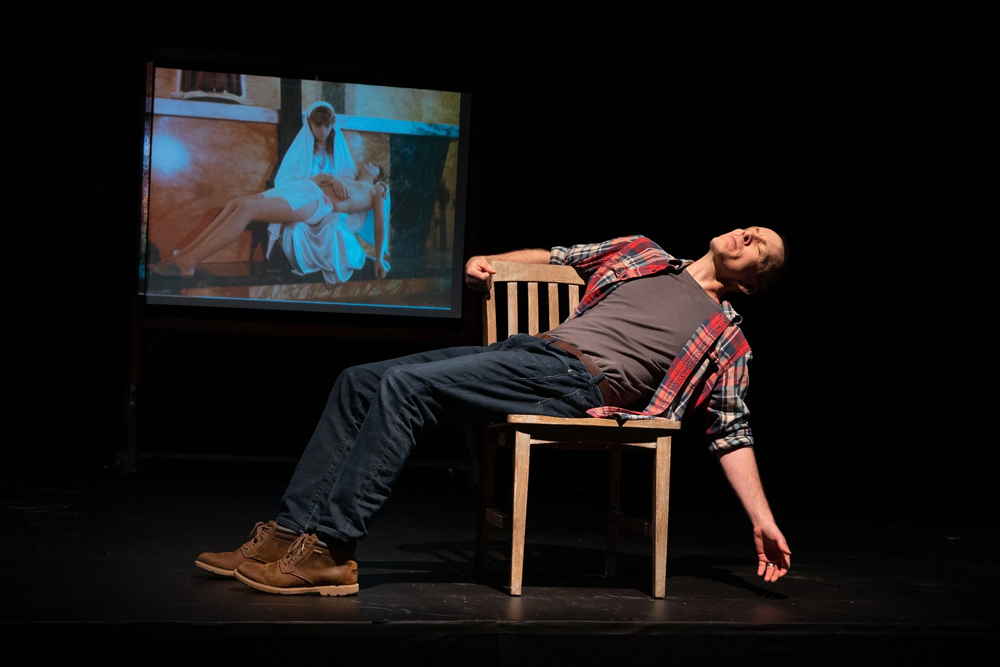
UNRECONCILED
A one-person play is, by its nature, usually intense.
When a one-person play is performed by its author, it is usually very intense.
When a one-person play deals with pedophilia, it is always very intense – and then some.
When a one-person play is performed by its author and deals with pedophilia by Catholic priests, it operates at a whole other level.
“UNRECONCILED” falls into that category.
The award-winning solo play “UNRECONCILED” opened its Pennsylvania tour in Exton on April 10 at Barley Sheaf Players and now heads to a multi-night homecoming run in Havertown from April 15–19 at JD McGillicuddy’s Pub (33 Brookline Boulevard, Havertown, www.unreconciledtheplay.com).
Fittingly, Havertown is the very community where the story is set and where writer/performer Jay Sefton grew up.
The 80-minute piece follows one survivor’s journey from silence to healing decades after childhood abuse in a Philadelphia suburb in the 1980s.
It has toured nationally and internationally, but this Pennsylvania run is unique — bringing a deeply personal story back to the neighborhoods that shaped it.
“UNRECONCILED,” which was written by Jay Sefton and Mark Basquill, returns to Pennsylvania for a powerful two-week, three-city tour in recognition of Child Abuse Prevention Month and Sexual Assault Awareness Month.
The tour supports legislation introduced by Representative Nate Davidson that would reform Pennsylvania’s statute of limitations and establish a retroactive two-year civil “look-back” window for survivors of childhood sexual abuse.
The tour will culminate April 22 at Gamut Theatre Group in Harrisburg, just steps from the Pennsylvania Capitol, the evening prior to anticipated Senate action on the bill.
The timing underscores a pivotal moment for survivors and lawmakers alike.
According to Sefton, who is Executive Director of The Unreconciled Project, “Survivors in Pennsylvania have been waiting for more than two decades for the chance simply to be heard in a court of law.
“Most other states have already opened look-back windows. We don’t need to keep asking why it hasn’t happened here. We just need to get it done.
“Performing in Harrisburg on the eve of potential legislative action is about reminding leaders that behind every policy debate are real people who deserve healing and justice.
“’UNRECONCILED’ tells the story of one survivor, but it speaks to thousands whose voices were silenced by fear, shame and outdated laws.”
Sefton is a Monsignor Bonner alumnus who graduated from West Chester University as a theater major.
He is the first-person narrator in “UNRECONCILED” and is basing his views on pedophile priests based on real experiences several decades ago.
Caution – graphic descriptions are included in this story.
“It happened in grade school at Annunciation BVM in Havertown,” said Sefton, during a phone interview last week as he was driving south to the Philly area from his home in East Hampton, Massachusetts.
“I was 13 and in eighth grade at Annunciation BVM. The priest was Father Thomas Smith — a parish priest who later got defrocked.
“We did a play at school – a Passion Play – and he was the director. In 1985, I was selected to play Jesus.
“Father Smith engaged in a lot of sadistic activity. He would whip me with whips that were fashioned out of Docksider shoes.
“Other students in the play and I had to get naked and go into a totally dark closet. These things went on for an entire spring.”
Father Smith’s misdeeds eventually caught up with him.
In September 2003 in the Court of Common Pleas First Judicial District of Pennsylvania Criminal Trial Division, the County Investigating Grand Jury brought charges against 28 priests for sexual abuse.
Father Smith was one of them.
The following was written about Father Smith –
“Father Thomas J. Smith, who engaged in depraved and sadistic behavior with many boys in previous parishes, lived until December 2004 at the rectory of Saint Francis of Assisi, a parish with a grade school in Springfield.
“He was permitted to celebrate daily and Sunday Masses and hear confessions.“
On March 12, 2004, the Archdiocesan Review Board unanimously found credible allegations that “Smith took at least three boys playing the role of Jesus in the parish Passion play into a private room, required them to disrobe completely,” pinned loincloths around them, and then, during the play, encouraged “other boys in the play to whip the Jesus character to the point where some of the boys had cuts, bruises and welts.”
“These actions, the Review Board found, “occurred in multiple parish assignments with a number of different boys over a number of years.”
“The board also credited reports that Fr. Smith had told boys that the rules of a club where he took them required that the boys and priest be nude to enter the club’s hot tub.
“Also contained in the priest’s Secret Archives file were reports that Fr. Smith regularly took boys camping and that he had fondled the genitals of at least one of those boys with whom he shared a tent.
“There were details from one of the victims who played Jesus in the Passion play, describing Fr. Smith, with pins in his mouth, kneeling in front of, and very close to, the boy’s genitals. The victim said that Fr. Smith would sometimes prick him with the pins until he bled.
“When Cardinal Bevilacqua learned of these accusations in May 2002, he chose to leave Fr. Smith in residence, and ministering, at Saint Francis of Assisi parish.
“Two and a half years later, after receiving additional reports that Fr. Smith had abused other boys, the Archdiocese removed the priest from active ministry.”
Sefton said, “In the play, did kids know something weird was going on? I don’t know if parents knew. I suspect some did.
“Father Smith groomed a lot of kids to be Jesus. But it was more than just the kids, he groomed the community.
“Parents like mine thought – it’s great. Our son is friends with the priest. To them, it was an honor.”
The Grand Jury heard that on May 10, 2002, 29-year-old Ian reported to the Delaware County District Attorney’s Office and to the Archdiocese the abuse he suffered as a 13-year-old at the hands of Fr. Smith.
In 1986, when the abuse occurred, Fr. Smith was assistant pastor at Annunciation B.V.M. Church in Havertown.
Ian described to Archdiocese and law enforcement officials how, in 1986, he had felt honored when his classmates at the parish grade school elected him to play the part of Jesus in the parish’s Passion play.
He told how the experience became such a nightmare that he, unsuccessfully, begged his parents’ permission to quit. Father Smith, who was director of the church play, subjected Ian to humiliating and sadistic torments for two months during the boy’s eigth-grade year.
Before every practice and every performance, while the other children dressed in the church basement with their teachers, Fr. Smith took Ian by himself to the sacristy, locked the door, and ordered the boy to undress.
The priest then took what Ian estimated to be 20 minutes to pin a costume – a loincloth and a cloak – on the boy. The ritual, according to Ian, was for the priest to kneel in front of the naked boy, uncomfortably close to his genitals.
In his mouth, the priest had the pins he would use to fasten the costume. Ian said that Fr. Smith sometimes touched his penis through the cloth and would “very often . . . poke me with these pins until I would bleed.”
During the play itself, Fr. Smith directed boys playing the parts of guards to whip “Jesus” with real leather straps. Ian said that these whippings gave him bruises, welts, and cuts.
Father Smith directed his plays in this fashion for years in several different parishes. He later explained that he wanted the boys to “live the part” of Jesus.
Ian told a Delaware County detective that he felt degraded by what Fr. Smith did to him and by what the priest directed others to do. He said that he began to drink alcohol after the practices and performances.
When he came forward in 2002, he had been recovering from alcoholism for 10 years. Ian also reported that Fr. Smith took boys to a hot tub at the Springton Racquet Club where the priest was a member.
Father Smith told the boys that it was a club rule that they had to be nude to use the tub, and the boys complied. Ian described how the priest paraded to the hot tub in front of the boys, without even a towel around his waist.
In the tub, Ian said, the priest constantly shifted around to try to get closer to the boys who were trying to move further away. An investigator for the Archdiocese Review Board found that there was no club rule – at least not in 2003 – requiring nudity to enter their hot tub.
Ian’s mother, who accompanied him to the interviews, told the officials of another victim. She said that the mother of “Peter,” a boy who, a few years earlier, had played Jesus in the Passion play, told her that Fr. Smith had done exactly the same things to her son.
She said that Peter had told his parents at the time, but that he was hysterical and did not want his parents to confront Fr. Smith. Peter’s father and some other parents had finally confronted Fr. Smith in 1991, and the priest had acknowledged that he had used bad judgment in how he conducted the Passion play.
Ian also told the detective and Msgr. Lynn and Fr. Welsh that his older brother Arthur had confided in him that Fr. Smith had molested him during a rafting and camping trip in 1984, when Arthur was 13 years old.
Ian said that Arthur had become very close to Fr. Smith at that time, and that in 2002 he still did not want to come forward because he feared embarrassment. Arthur had told Ian, though, that while sleeping in the same tent with Fr. Smith, the priest had “touched” and “grabbed” the boy’s genitals.
The Archdiocese interviewed Father Smith but did not act.
Fr. Smith readily admitted the numerous incidents in which he humiliated boys by forcing them to undress in front of him, but he denied any touching of genitals.
Msgr. Lynn asked Fr. Smith whether there were “inappropriate things [we] need to worry about.” Cardinal Bevilacqua apparently was assured enough to leave Fr. Smith as Vicar of Delaware County and resident priest at Saint Francis of Assisi.
“Father Smith groomed the families and they trusted him,” said Sefton, who is now a mental health counselor in Massachusetts.
“He would take boys to his house at the Jersey shore and ski trips where there was always inappropriate touching. And there was always drinking around him with the boys and him.”
Looking back, it seems as if there was a playbook for pedophile priests which they would faithfully follow.
I experienced it first-hand at St. Francis of Assisi parish in Norristown in the mid-1960s with a priest named Father Francis Rodgers.
The pattern was the same.
He had a house in Ocean City where he would bring his group of boys for weekend romps complete with packing sand in swimsuits, hands-on naked showers, drinking and a lot of miscellaneous fondling.
After just one trip to O.C., I had seen and experienced enough.
But if I told my parents a priest fondled me, they wouldn’t have believed me and, even if they did, they would silence me to avoid any problems in the parish.
I knew that a battle between me and the parish clergy and my parents was unwinnable. So, I dealt with it my own way.
I was an altar boy and one Sunday was serving a Mass with Fr. Rodgers. As we exited the sacristy, Fr. Rodgers reached around and grabbed my genitals.
I spun around and grabbed him by the neck.
I told him – if you ever touch me again, I’m going to knock you out and then we’ll deal with the explanations of what occurred and why.
Father Rodgers never touched me again – but I was no longer a part of his select group of victims.
Eventually, his deeds caught up with him – more or less.
However, the Archdiocese had its own playbook. Whenever there was heat about a priest’s abusive behavior in one parish, they would transfer him to a different parish. This happened many times with Father Rodgers.
According to the same Grand Jury report –
“The Grand Jury will never be able to determine how many boys Father Francis P. Rogers raped and sexually abused in his more than 50 years as a priest.
“Nor, probably, will we or anyone else be able to calculate the number of boys the Archdiocese could have saved from sexual abuse had it investigated potential victims rather than protecting itself from scandal and shielding this sexually abusive priest.
“We have learned of at least three victims who we believe would not have been abused had the Archdiocese taken decisive action when it learned of Fr. Rogers’ “familiarity” with boys.
“We find that the Archdiocese received a litany of verifiable reports beginning shortly after Fr. Rogers’ 1946 ordination and continuing for decades about his serious misconduct with, and abuse of, boys.
“One of his victims described waking up intoxicated in the priest’s bed, opening his eyes to see Fr. Rogers, three other priests, and a seminarian surrounding him. Two of the priests ejaculated on him while Fr. Rogers masturbated himself.
“Then Fr. Rogers sucked on the victim’s penis, pinched his nipples, kissed him, and rubbed his stubbly beard all over him. The former altar boy, whom Fr. Rogers began abusing when he was about 12 years old, remains haunted by memories of the abuse more than 35 years later.
“Father Rogers’ file demonstrates that the Archdiocese responded to reports of his crimes with a shameful half-century of transfers, excuses, and finger-wagging threats that did nothing to deter the priest from indulging his self-acknowledged “weakness” and that exposed every boy in his path to the very real and horrible possibility of sexual abuse.”
Unfortunately, the laicization of Father Rodgers never happened.
Father Rogers was never punished or held to account for his unchecked sexual predations or the devastation they caused.
He was permitted to retire in 1995, his “good name” intact. The message clearly communicated by the Archdiocese’s actions – to victims and abusers alike – was that it would protect the reputation of its priests at all costs.
According to Sefton, “Performing ‘UNRECONCILED’ in Pennsylvania during Child Abuse Prevention Month amidst a legislative push for statute of limitations reform is a chance to use theater as a tool to hopefully move audiences and policy.”
The tour supports legislation introduced by Representative Nate Davidson that would reform Pennsylvania’s statute of limitations and establish a retroactive two-year civil “look-back” window for survivors of childhood sexual abuse.
Time is running out for lawmakers to pass a constitutional amendment allowing child sex abuse survivors to sue their abusers or institutions on claims that would fall beyond the statute of limitations to bring those cases to civil court.
If the proposal doesn’t pass this year, the rules surrounding constitutional amendments mean the measure couldn’t pass until 2029 at the earliest.
According to Davidson, D-Harrisburg, a chief sponsor of the constitutional amendment, “I don’t know why we would find it acceptable for an additional two-year delay of our creation.”
The “UNRECONCILED” tour will culminate April 22 at Gamut Theatre Group in Harrisburg, just steps from the Pennsylvania Capitol, the evening prior to anticipated Senate action on the bill.
The timing underscores a pivotal moment for survivors and lawmakers alike.
House Bills 462 and 464 have already passed the Pennsylvania House of Representatives and now await action in the State Senate. Similar retroactive civil windows have been enacted in the majority of U.S. states, leaving Pennsylvania among a shrinking minority without a path for many survivors to pursue long-barred civil claims.
More than 20 years after the first Pennsylvania grand jury report exposed widespread child sexual abuse, a retroactive look-back window remains the final major reform yet to be implemented.
“Survivors in Pennsylvania have been waiting for more than two decades for the chance simply to be heard in a court of law,” said Sefton.
“Performing in Harrisburg on the eve of potential legislative action is about reminding leaders that behind every policy debate are real people who deserve healing and justice.
“‘UNRECONCILED’ tells the story of one survivor, but it speaks to thousands whose voices were silenced by fear, shame and outdated laws.
“Performing in Pennsylvania during Child Abuse Prevention Month amidst a legislative push for statute of limitations reform is a chance to use theater as a tool to hopefully move audiences and policy.”
“UNRECONCILED” is a story of courageousness and perseverance which inspires us all to enact meaningful reform.
At each of the tour stops, post-show talk backs will take place with a range of advocates including actor and survivor, Anthony Edwards (ER, Top Gun), who will be making an appearance at the April 19 Havertown location along with survivor, advocate and attorney Sarah Klein.
Klein is a former competitive gymnast, a 2018 ESPY Award winner and was the first known victim of former Olympic women’s gymnastics doctor Larry Nassar.
Video link for “UNRECONCILED” – https://vimeo.com/961145887?fl=pl&fe=cm.
The performances in Havertown are scheduled for 7:30 p.m. April 16-18 and 2:30 p.m. on April 19. Tickets are $28.
The free show in Harrisburg on April 22 at Gamut Theatre Group (15 North Fourth Street, Harrisburg) will start at 5 p.m.